If you've ever tried to find a quiet place to study in Brussels in the week before exams, you know the routine. The university libraries are full. The good cafés are full. You walk to a co-working space and they're full. You spend an hour finding a spot before you even open a book.
Brik set out to fix that, not by building more study spaces, but by making the existing ones findable and bookable. They partner with libraries, co-working hubs, and other quiet spaces across Brussels, aggregate them into one platform, and let students reserve a desk the way they'd reserve a restaurant table.
Who is Brik?
Brik is the student-housing actor for Brussels: a city-wide organisation that helps students find their way in the capital, from housing to study spaces to practical info. The Study Spaces platform is one of their flagship digital services.
The challenge
Two problems, one platform.
The first was discovery: a student should be able to enter where they are, when they want to study, what they need (silent room? group room? near a metro stop?), and get a real-time view of what's available. No phone calls, no checking five websites, no walking to a location to find it's full.
The second was scale. The platform sits idle most of the year, and then, twice a year, thousands of students hit it within the same two-week exam window. A traditional always-on server setup would either be wasted capacity 80% of the time, or buckle when it mattered most.
What we've built
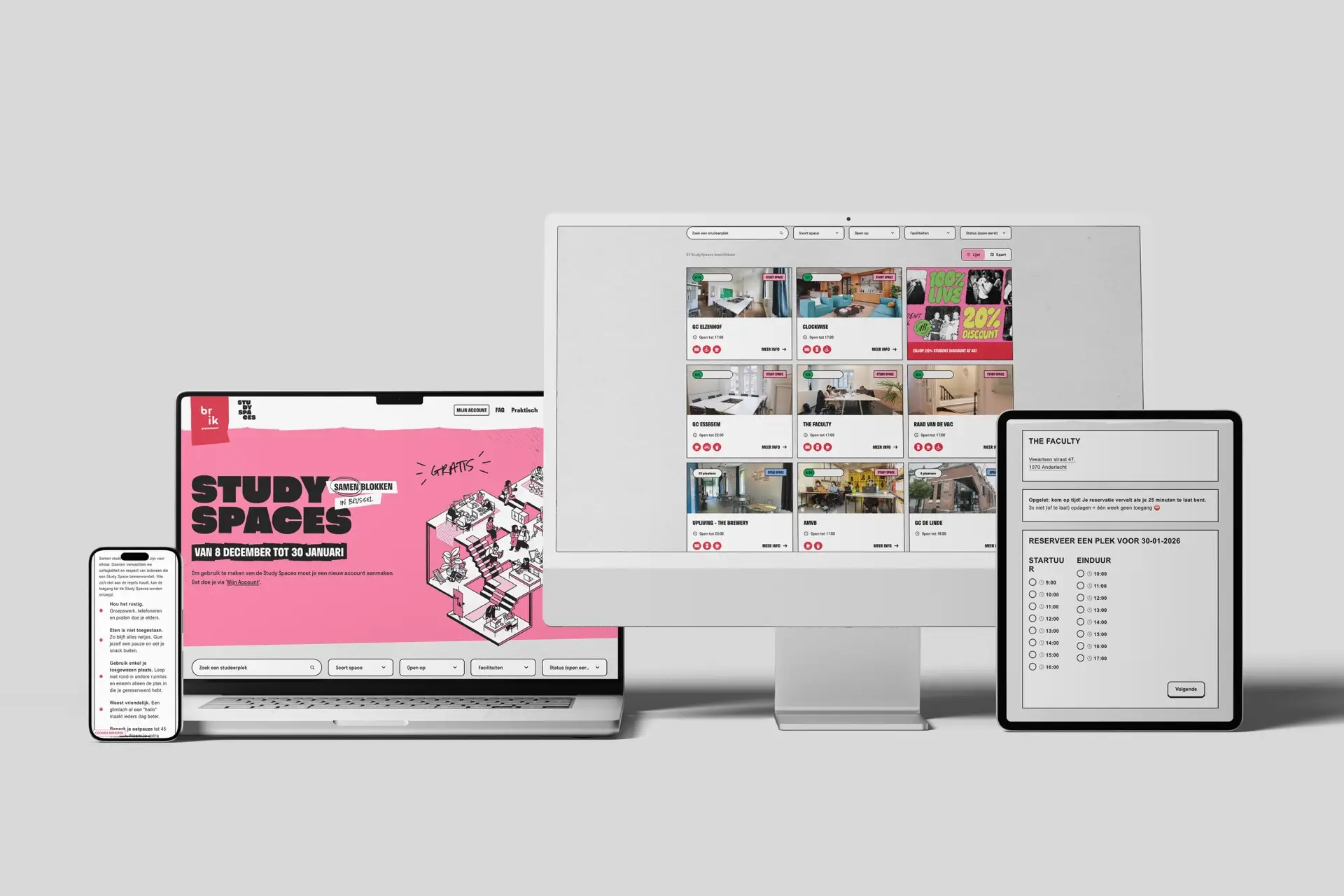
We built Brik Study Spaces as a modular Laravel platform with a clean booking flow at the front and a comprehensive admin layer underneath. Students enter their preferences and see what's available across all partner locations. Each spot shows its facilities, opening hours and capacity, so by the time someone clicks "reserve" they already know what they're walking into.
The modular architecture matters more than it sounds. Over the past few years we've added new features, new types of spaces, new partner integrations, new filtering options, without rebuilding what came before. The platform grew with Brik's needs instead of fighting them.
For the scale problem, we put the whole environment on Kubernetes. During quiet months the infrastructure runs lean and cheap. When exam week starts and traffic spikes, the platform automatically scales up to handle thousands of concurrent students, then scales back down when it's over. Brik pays for what they actually use.
Working together
Brik came to us with an existing platform and a partial redesign. We took the new design and translated it into an accessible, responsive web environment, then kept building from there. What started as a redesign project has become a long-term collaboration, the kind where each year's improvements compound on the last.
"Anything is possible. Vulpo is happy to brainstorm new ideas and is capable of putting them into practice." — Brik
The result
Brik Study Spaces is now a stable, scalable platform that students actively use during the moments that matter most. The infrastructure scales without anyone watching it. The codebase scales without becoming a tangle. And every year, the platform handles more spaces, more students, more bookings, without the team behind it growing at the same rate.